This blog explores capacity-aware automation and how businesses can build flexible, human-centered systems that support async work, reduce operational overload, and enable sustainable growth.
Capacity-aware automation is redefining how modern organizations approach productivity, operational efficiency, and business resilience. For years, automation has been measured by one primary outcome: speed. Businesses automated repetitive tasks, streamlined workflows, and accelerated operations in pursuit of higher productivity. While these outcomes remain valuable, today's operating environment demands a more balanced approach.
As organizations grow, they often introduce more software, more processes, and more channels of communication. Ironically, these investments, intended to improve efficiency, can increase complexity. Employees find themselves navigating multiple applications, responding to a constant stream of notifications, and switching between tasks more frequently than ever before. The result is operational friction, reduced focus, and growing cognitive overload.
This shift is reflected in recent workplace research. According to the Microsoft 2024 Work Trend Index, employees are increasingly turning to AI and automation to manage growing workloads, yet many organizations still struggle to redesign work in ways that truly improve productivity. The report found that 75% of knowledge workers now use AI at work, signalling that technology adoption is accelerating, but sustainable value depends on how work itself is designed, not simply on the tools being deployed. Microsoft Work Trend Index 2024
Capacity-aware automation addresses this challenge by shifting the conversation from "How can we automate more?" to "How can we automate better?" Rather than expecting people to constantly adapt to technology, it encourages organizations to design systems around human capacity, enabling employees to do meaningful work without being overwhelmed by unnecessary operational demands.
At its core, capacity-aware automation combines automation, asynchronous work, and flexible system design to create workflows that respect how people actually work. It removes repetitive effort, reduces unnecessary interruptions, and supports sustainable performance without compromising business agility.
For business leaders, this represents more than an operational improvement. It is a strategic advantage. Organizations that build systems around human capacity are better positioned to adapt to change, improve employee experience, and scale without creating operational bottlenecks.
In this article, we'll explore what capacity-aware automation is, why it matters, and how businesses can implement it to build resilient, people-centered operations that are prepared for the future of work.
Capacity-aware automation is a systems design approach that aligns automation, workflows, and operational processes with the real human capacity of the people who use them.
Unlike traditional automation, which focuses primarily on speed, efficiency, and task reduction, capacity-aware automation focuses on sustainable execution, ensuring that work moves smoothly through systems without overwhelming teams, creating unnecessary urgency, or increasing cognitive load.
At its core, capacity-aware automation is not just about automating tasks. It is about designing operational environments where people and systems work in balance.
Traditional automation typically asks a technical question:
“What can we automate to make this faster?”
Capacity-aware automation asks a more strategic and human-centered question:
“How can we automate this in a way that respects how much people can realistically process, decide, and execute?”
This distinction is critical because it shifts automation from a purely technical implementation to a business design strategy.
Capacity-aware automation is built on four foundational principles:
Systems are designed around attention span, workload limits, and cognitive load, not just process efficiency.
Work is structured so tasks can progress without requiring real-time coordination or immediate response.
Automation is used not just to speed up work, but to reduce the mental effort required to manage it.
Instead of automating isolated tasks, the focus is on designing connected systems that manage entire workflows end-to-end.
In real business environments, capacity-aware automation often includes:
These systems allow work to continue flowing even when individuals are not actively engaged in real-time coordination.
Many organizations mistakenly believe they are “fully automated” because they have implemented tools like CRM systems, project management software, or workflow automation platforms.
However, without capacity awareness, these tools often lead to:
Capacity-aware automation solves this by ensuring that automation is not only efficient, but also operationally sustainable.
Research from McKinsey & Company highlights that organizations achieve significantly higher performance gains when they redesign workflows alongside automation, rather than simply digitizing existing processes. McKinsey Future of Work Insights
Similarly, the World Economic Forum emphasizes that future-ready organizations must integrate flexibility, digital systems, and human-centered design into their operational models to remain competitive in rapidly changing environments. WEF Future of Work Trends
These insights reinforce a key point: automation alone is not enough. The structure around it determines its impact.
Many organizations are now experiencing what can be described as a scaling tension point:
Without intervention, this cycle continues until systems become the bottleneck instead of the enabler.
Capacity-aware automation interrupts this cycle by introducing:
Businesses that adopt capacity-aware automation gain more than efficiency improvements. They gain operational resilience.
This means:
This is where capacity-aware automation becomes a strategic advantage, not just an operational improvement.
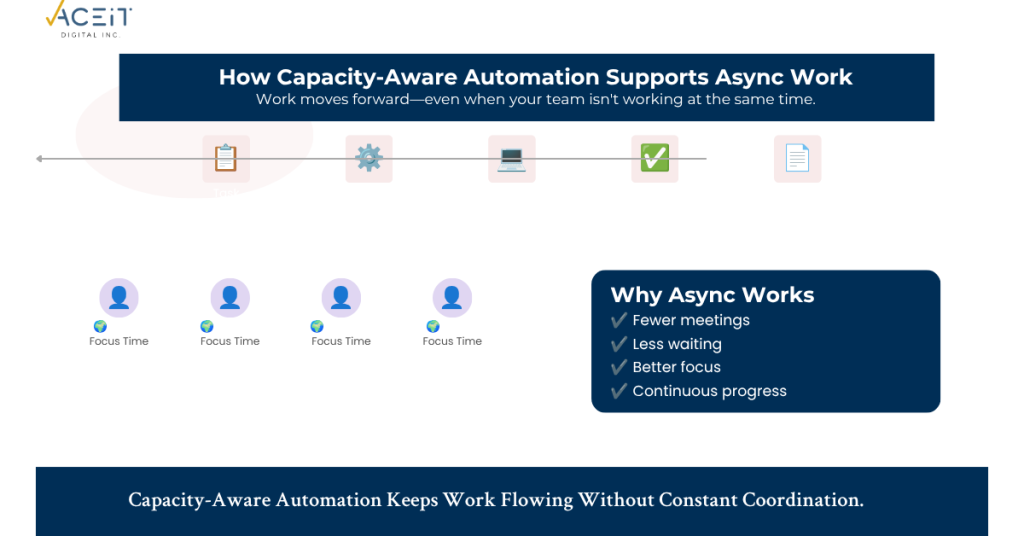
Capacity-aware automation supports async work by ensuring that business processes continue to move forward without requiring real-time coordination, constant supervision, or immediate responses from team members.
In traditional work environments, progress often depends on synchronous communication—meetings, instant replies, and real-time approvals. While this can work in small teams, it becomes inefficient and restrictive as organizations scale or operate across multiple time zones.
Capacity-aware automation removes this dependency by designing workflows that progress independently of human timing.
Async work is not simply about working remotely or replying later. It is about structuring work so that:
Without capacity-aware design, async work quickly becomes fragmented and slow.
This is because simply delaying communication does not solve the underlying problem of workflow dependency.
Capacity-aware automation strengthens async work by introducing structured flow into how tasks, information, and decisions move through an organization.
Instead of relying on people to push work forward manually, systems handle progression automatically.
Work moves through stages based on predefined rules, not manual updates.
Example:
This removes the need for constant checking and follow-ups.
Instead of requiring real-time approvals, decisions are structured into workflows.
This ensures that decision-making does not block execution.
Capacity-aware systems reduce dependency on asking people for updates.
Instead:
This significantly reduces interruptions and communication overload.
Not all updates require immediate attention.
Capacity-aware automation ensures that:
This protects focus time and reduces cognitive fatigue.
When capacity-aware automation is applied to async workflows, teams experience a fundamental shift in how work feels and flows.
Instead of reacting to constant interruptions, teams can:
This leads to a more stable and predictable operating rhythm.
Research from Microsoft shows that modern employees are increasingly using digital tools and AI to manage workload complexity, but productivity gains depend heavily on how well workflows are structured—not just the tools themselves. Microsoft Work Trend Index
This reinforces a key insight:
Technology enables async work—but system design determines whether it actually works.
It’s important to note that async work alone is not a solution.
Without capacity-aware automation, async environments often suffer from:
This is why capacity-aware automation is essential, it provides the structure that async work depends on.
.
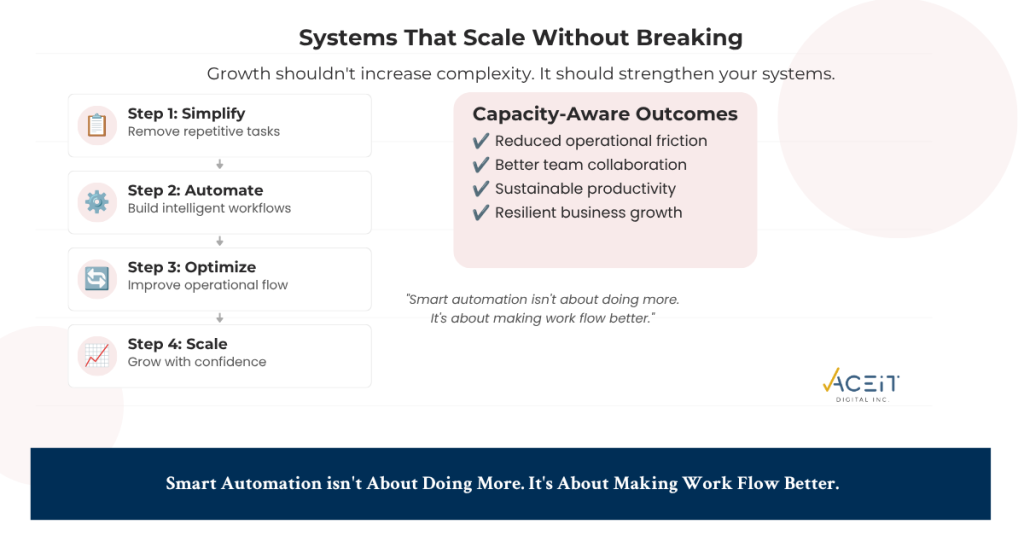
Capacity-aware automation creates flexible systems by designing workflows that adapt to changing business demands, team availability, and operational complexity without breaking down or increasing workload pressure.
In most growing organizations, systems are built for stability at a small scale. As demand increases, these same systems begin to strain. Tasks pile up, approvals slow down, and teams become overloaded. The problem is not growth itself—it is the lack of flexibility in how work is structured.
Capacity-aware automation solves this by introducing adaptive system design into business operations.
Business environments today are not static. They shift constantly due to:
Rigid systems struggle in this environment because they depend on fixed capacity assumptions.
Flexible systems, on the other hand, adjust automatically based on conditions.
Capacity-aware automation builds flexibility into systems through structured design principles.
Tasks are not assigned manually in rigid sequences. Instead, they are distributed based on:
This ensures no single team or individual becomes a bottleneck.
Workflows are designed to expand without redesign.
As volume increases:
This prevents system breakdown during growth phases.
Capacity-aware systems distribute work intelligently across teams.
This reduces:
It ensures operational stability even under pressure.
Instead of assuming immediate processing, flexible systems introduce buffers such as:
This prevents overload during peak demand periods.
Traditional systems often fail because they assume predictable conditions.
For example:
These structures work in controlled environments but collapse under scale.
Capacity-aware automation replaces rigidity with adaptive logic, allowing systems to adjust without constant human intervention.
When capacity-aware automation is implemented effectively, organizations experience:
Most importantly, growth becomes less disruptive.
Instead of adding pressure, scaling becomes a controlled extension of existing systems.
This reinforces a key principle:
Tools scale capability. Systems determine sustainability.
The most important advantage of capacity-aware automation is not speed, it is stability under growth.
Businesses can expand operations without:
Instead, systems absorb complexity while maintaining clarity.
Capacity-aware automation improves business growth by creating systems that are not only efficient, but also sustainable, scalable, and resilient under operational pressure.
While traditional automation focuses on increasing output, capacity-aware automation focuses on maintaining performance quality as complexity increases. This distinction is what allows businesses to grow without experiencing the typical breakdowns that come with scaling.
One of the most immediate benefits of capacity-aware automation is improved efficiency that does not come at the expense of team well-being.
Instead of pushing teams to work faster or handle more tasks manually, capacity-aware systems:
This allows teams to focus on meaningful work rather than operational noise.
Efficiency becomes a byproduct of better design, not increased effort.
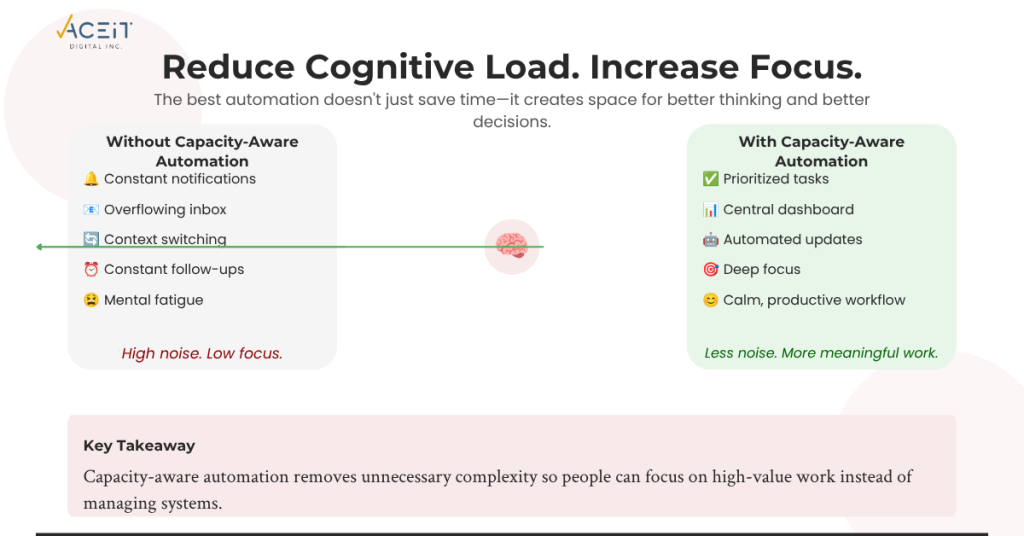
In many organizations, burnout is not caused by workload alone but by constant context switching and system pressure.
Capacity-aware automation reduces this by:
This creates a calmer working environment where employees can focus deeply without constant interruptions.
According to the World Economic Forum, future workplace models will increasingly prioritize human-centered systems that support well-being alongside productivity as a key factor in long-term organizational resilience. WEF Future of Work
Decision-making often becomes a bottleneck in growing organizations.
Capacity-aware automation improves this by:
This results in decisions that are not only faster but also more consistent and traceable.
Instead of decisions being delayed by availability, they progress through a structured system.
Scalability is not just about handling more work, it is about handling more work without increasing complexity at the same rate.
Capacity-aware automation enables scalability by:
This ensures that growth does not create operational instability.
Resilience refers to how well a business continues functioning under pressure, change, or uncertainty.
Capacity-aware automation strengthens resilience by ensuring that:
This creates a business model that is stable even in changing environments.
Operational systems directly influence employee experience.
When systems are poorly designed, employees often feel:
Capacity-aware automation improves this by creating clarity and reducing friction.
Employees gain more control over their work, which leads to:
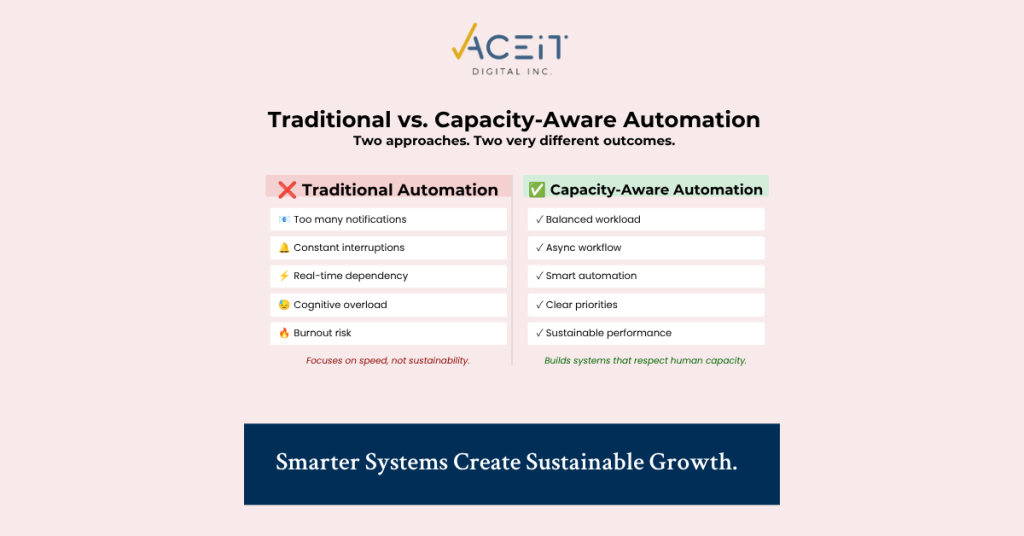
To fully understand the shift in thinking, it is important to compare traditional automation with capacity-aware automation at a structural level.
| Traditional Automation | Capacity-Aware Automation |
| Focuses on speed and task efficiency | Focuses on balance, flow, and sustainability |
| Assumes constant human availability | Assumes human variability and capacity limits |
| Optimizes individual tasks | Optimizes entire systems and workflows |
| Often real-time dependent | Designed for async execution |
| Can increase notifications and pressure | Reduces cognitive load and operational noise |
| Works in isolation (task-level automation) | Works as a connected system (end-to-end workflows) |
| Improves output volume | Improves long-term operational stability |
This comparison highlights a key shift:
from automation as speed → to automation as system design.
Capacity-aware automation does not require a complete system overhaul. It starts with small, intentional changes in how work is structured.
Look for areas where:
Replace repetitive coordination tasks with:
Shift from real-time dependency to structured flow:
Focus on:
This ensures automation supports the entire system—not isolated actions.
Capacity-aware automation is not just an operational improvement—it is a shift in how businesses design work itself.
As organizations scale, complexity naturally increases. Without intentional system design, this complexity turns into overload, inefficiency, and burnout. However, when businesses adopt capacity-aware automation, they create systems that are not only more efficient but also more resilient and human-centered.
The future of work will not be defined by how much businesses automate, but by how intelligently they design systems that support human capacity.
Organizations that embrace this approach will:
In a world where attention is limited and complexity is rising, capacity-aware automation is not optional, it is strategic.
If your business is growing but your systems feel increasingly difficult to manage, the issue may not be effort; it may be structure.
At Aceit Digital, we help organizations design smarter workflows, implement capacity-aware automation, and build operational systems that scale with people, not against them.
👉 Take the Secure Growth Boundary Assessment to uncover hidden operational bottlenecks and system inefficiencies limiting your growth.
The insights, research, and industry trends discussed in this article are informed by the following authoritative sources:
 Group Coaching Program Planner
Original price was: $45.00.$27.50Current price is: $27.50.
Group Coaching Program Planner
Original price was: $45.00.$27.50Current price is: $27.50.

